
Rother Local Plan 2025-2042 Regulation 19 (pre-submission) version September 2026
Chapter 4: A Thriving Local Economy
Policy ECO1: Supporting a Thriving Local Economy Comment
|
Status |
Strategic |
|
Priorities |
Green to the Core, Live Well Locally, Thriving Local Economy |
|
Strategic Objectives |
3, 4, 5, 6, 8 |
|
|
|
Key evidence and/or guidance
|
|
4.1National planning policy requires Local Plans to set out a clear economic vision and strategy which positively and proactively encourages sustainable economic growth. This policy helps give effect to the Government’s Industrial Strategy[90] and the East Sussex Economic Prosperity Strategy, which provide a strategic framework for coordinating investment and economic development across the wider East Sussex area. The policy recognises the important role that Rother has in the regional context and seeks to respond to the district’s business development challenges and needs, together with building on its existing economic strengths and opportunities.
4.2Evidence indicates that Rother district forms part of a ‘Functional Economic Market Area’ (FEMA) with Hastings borough. While there are commuting links between Rother, Hastings and other neighbouring authorities (namely Eastbourne, Wealden and Tunbridge Wells) the commuting links within and between Hastings and Rother are significantly stronger, equating to an overall self-containment rate of 79 per cent.[91] It is therefore important that Rother is not considered in isolation for economic development and forward planning.
4.3Whilst the FEMA is located within the prosperous South East, the geography of the area presents challenges that impact significantly on its economy, in contrast with the wider region. For example, the two major towns of Bexhill and Hastings are coastal centres which, like many others in the southeast and elsewhere in England, have experienced persistent economic challenges. Furthermore, the characteristically rural nature of Rother, including a high proportion of the land being within the High Weald National Landscape, presents land-use constraints for new major industrial and commercial development in the countryside.
4.4Workforce qualification levels across the FEMA are lower than regional and national averages, while the proportion of the workforce in Rother with no qualifications is noticeably greater still. There are skills gaps particularly for higher-skilled and specialist technical jobs. This in turn is reflected by a comparatively lower-paid job profile and pressures on the cost of living, which has been exacerbated with rising housing costs. For instance, house prices in Rother were more than 12-times the median earnings in 2022[92]. There are wide economic disparities between areas within Rother, with the most deprived areas in parts of Bexhill and Rye, ranking amongst the highest in the country. For sustainable economic development, there is an imperative to improve the qualifications of the working age population to enhance access to higher-skilled jobs and support business productivity.
4.5 Despite these challenges there are important opportunities for economic growth and business development in Rother. The district contains the town centres of Bexhill, Rye and Battle along with the district centres of Sidley and Little Common. These centres, together with villages dispersed across the district, provide focal points for commercial and community activity. Rye Harbour is a key employment location particularly for industrial uses, together with established industrial estates within Bexhill, on the Hastings Fringes and elsewhere within the district. Rural economic activities, including agriculture and equestrian uses will continue to remain important to Rother. Agricultural and other land-based business diversification can support the resilience of this sector in the future.
4.6Rother is also well poised to build on its strengths as a key visitor and leisure destination, given its wide range of natural and heritage assets. These include the coastline and attractive beaches, High Weald National Landscape and historic market towns as well as the Rye Citadel, Battle Abbey and proximity to the Hastings Battlefield. Tourism attracted some 5.61 million trips to Rother in 2022, with annual visitor expenditure amounting to some £202 million (equivalent to £16.8 million per month). Some 5,800 jobs in Rother are supported by the visitor economy, and it is estimated that 21.6% of the district’s population is employed directly or indirectly as a result of tourism.[93]
4.7The delivery of new and improved infrastructure will be vital for inward investment and to unlock opportunities for business growth and development, as well to enhance the wider community’s access to job and training opportunities. This includes transport and digital infrastructure required for modern economic activities. The delivery of such infrastructure will also support objectives around climate change and decarbonisation to achieve net zero emissions.
4.8Subsequent policies in this chapter address these different aspects of economic growth in Rother.
Policy ECO2: New Employment Development Comment
|
Status |
Strategic |
|
Priorities |
Green to the Core, Live Well Locally, Thriving Local Economy |
|
Strategic Objectives |
6, 7, 8, 11 |
|
|
|
Key evidence and/or guidance
|
|
4.9This policy helps give effect to the economic development strategy, as set out in Policy ECO1 (Supporting a Thriving Local Economy), as well as the spatial strategy, by ensuring that all new employment development is appropriately located and designed to a high-quality.
4.10The policy seeks to direct new development to existing employment areas and centres, where businesses can benefit from a complementary cluster of uses and to enable people to access jobs locally. Some site allocation policies include provisions for new employment uses to be delivered in order to meet identified needs, as well as to support sustainable communities. New employment development in the countryside will need to be carefully managed in order to protect local character and the High Weald National Landscape, however it is recognised that new employment land and business space can support rural economic activities.
4.11Like all development, new employment development must be designed to respond positively to its local context. Some employment uses, such as industrial and warehousing uses, have the potential to impact significantly on local amenity. Careful consideration is therefore needed to the location, layout and design of development along with the nature of uses. The policy should be read together with other Local Plan policies covering design as well as good practice guidance, including the National Design Guide. Where possible, buildings and spaces should be designed to be flexibly specified and adaptable to a wide range of end users. This will help to ensure that development remains viable for employment uses over the long-term and can respond to the changing requirements of modern businesses.
4.12Development proposals must demonstrate that there will be no adverse impacts on the highway network and public safety, with appropriate arrangements for parking. Proposals impacting the Strategic Road Network (SRN) must include a Transport Assessment and Travel Plan, as outlined in Circular 01/2022. Where the development will create a need for new parking, this will need to be compliant with East Sussex County Council’s Guidance on Parking at New Developments.
Policy ECO3: Safeguarding Employment Land & Premises Comment
|
Status |
Strategic |
|
Priorities |
Live Well Locally, Thriving Local Economy |
|
Strategic Objectives |
6, 9 |
|
|
|
Key evidence and/or guidance
|
|
4.13For the purpose of the Local Plan and this policy, employment uses are defined as uses covered by Class E(g) (offices, research and development, light industrial), Class B2 (general industrial) and Class B8 (storage and distribution), as set out in the Town and Country Planning (Use Classes) Order. They also cover employment related Sui Generis uses which will be established on a case-by-case basis, having regard to the nature of the use and relevant legislation.[94]
4.14Planning legislation allows some changes of use between use classes without the need for a planning application, where certain conditions are satisfied. Subsequently, this policy only applies in cases where planning permission is required.
4.15National planning policy requires the Local Plan to make sufficient provision for identified employment needs. The joint Hastings and Rother Housing and Economic Development Needs Assessment Update (2026) provides the latest evidence of need for employment land and floorspace in the district and has been informed by job growth forecasts. The HEDNA concludes that 26.2 hectares of employment land are required in Rother over the plan period. The breakdown of this need is set out in Figure 4.1 below.
Figure 4.1: Rother employment land requirements 2025-2042, by type (hectares)
|
E(g) (i and ii) |
E(g)(iii) / B2 |
B8 |
Total |
|
Office / research and development |
General industrial |
Storage and distribution |
|
|
4.4 |
8.0 |
13.9 |
26.2 |
4.16When the existing development pipeline is taken into account, a significant amount of this need is set to be addressed through planning commitments, leaving a shortfall of 0.8 hectares of employment land, the breakdown of which is set out in Figure 4.2 below.
Figure 4.2: Rother employment land demand/supply balance 2025-2042, by type (hectares)
|
E(g) (i and ii) |
E(g)(iii) / B2 |
B8 |
Total |
|
Office / research and development |
General industrial |
Storage and distribution |
|
|
+9.7 |
-1.6 |
-9.0 |
-0.8 |
4.17The updated supply and demand balance assessment identifies a residual requirement of approximately 0.8 ha overall. However, this headline position masks a more significant difference by use class. There is an identified surplus of around 9.7 hectares for class E(g)(i) and (ii) uses, but residual requirements of around 1.6 hectares for class E(g)(iii)/B2 uses and 9.0 ha for B8 uses.
4.18The Local Plan makes sufficient provision of land to meet the overall quantum of identified employment needs in full. The need will be met through a combination of supply from site allocation policies (including new employment allocations and carrying forward undelivered sites from the Development and Site Allocations Local Plan, where appropriate) and the current development pipeline (schemes that are consented and/or under construction and due to be completed within the plan period).
4.19The employment land portfolio will need to be carefully managed over the plan period. This is in order to ensure a sufficient supply of land and space in Rother to meet the needs of business now and in the future. Given the identified need and current supply position, this policy seeks to safeguard land and premises that are currently in or allocated for employment use. The policy also makes provisions for rebalancing of the employment land portfolio to better meet identified needs. It therefore seeks to encourage and support changes of use to industrial and warehousing uses on appropriate sites, where local needs are now greatest.
4.20 To ensure the Local Plan takes a positive approach to development and can respond to changes in economic or other circumstances that may arise over the plan period, the policy, together with Policy ECO4, provides flexibility for the loss of employment land in limited cases.
Policy ECO4: Retention of Sites of Economic or Community Value Comment
|
Status |
Strategic |
|
Priorities |
Live Well Locally, Thriving Local Economy |
|
Strategic Objectives |
6, 9 |
|
|
|
Key evidence and/or guidance
|
|
4.21Employment sites and premises, community facilities, local shops, tourist attractions and accommodation, holiday sites and leisure facilities all play an important economic and social role within the district, making a positive contribution to maintaining and developing sustainable communities. At the same time, there are commercial pressures for such sites and uses to change to alternative higher value uses, such as housing. This often leads to local concerns about the loss of facilities and job opportunities. The erosion of sustainable communities and harm to the local economy is at the heart of concerns. It follows that it is vital to provide a clear policy framework to consider proposals involving losses of such uses.
4.22The principle of the retention of sites for uses that require protection through the Local Plan is established through Policy ECO3 (Safeguarding Employment Land & Premises) in respect of employment uses; Policy ECO7 (Tourism Activities, Facilities & Accommodation) for tourism activities, facilities and visitor accommodation; and Policy ECO4 for sites of community use including local shops, services and facilities. Collectively, these policies establish that sites of economic and community value, as defined by their respective policies, are normally retained, and their loss resisted unless it is evident that they cannot be maintained or that their continued use would perpetuate real harm to local amenities in some way. This policy sits alongside the above strategic policies by setting out the requisite marketing and viability evidence required to properly decide what constitutes no reasonable prospect of continued use. It is acknowledged that there is a raft of “permitted development” rights affecting some economic and community uses, particularly those within Use Class E, meaning that some changes of use do not require an application for full planning permission. The policies provide the framework for decision making when planning permission is required.
4.23To satisfy the policy test to change one of the protected uses as detailed in the policy, a comprehensive, sustained marketing campaign must be undertaken, offering the premises for sale or for rent, at a realistic valuation of the premises for the permitted use. Ordinarily, the marketing campaign should run for a period of at least 18 months before the planning application is submitted, with the premises offered for sale locally and regionally in appropriate publications including through trade agents. Details must accompany relevant planning applications, including two independent valuations of the building in its current condition/state.
4.24Sites must be advertised with the option of an alternative commercial or community facility, appropriate to the site and in line with other policies in the Local Plan. Where applications relate to a public house, the property must be advertised free of tie and restrictive covenant. Applications must also have full regard to the provisions set out in the Campaign for Real Ale (CAMRA) Public House Viability Test. Where a proposal relates to the loss of tourist accommodation it will be considered against a range of quality measures such as independent customer reviews, trading standards reports, environmental health reports and industry insight, to determine whether the site is genuinely unsuitable.
4.25In terms of financial viability evidence, the Council will ordinarily require submission of trading accounts for the last three full years in which the business was operating on a full-time basis. In schemes affecting tourism accommodation, consideration will also be given to the adequacy of marketing measures to attract holiday lettings. Where an applicant wishes to make a case that a site is not, or is not capable of being financially viable, evidence must demonstrate the viability of alternative commercial or community facilities, where appropriate. The Council will then obtain independent verification of the viability evidence submitted, which is to be undertaken at the developer’s expense. Applications must also be accompanied with supporting information to demonstrate how the applicant has brought forward measures to improve viability of the business over the short/medium/long-term. This would also help to ensure that the policy requirements draw a distinction between businesses that are no longer viable and those that are not being run effectively. The Council’s National and Local List of Planning Application Requirements expands on the evidence to be supplied in support of a proposal under this policy.
4.26Criterion 4 of the policy allows the Council to take a flexible approach in applying the other policy requirements in limited situations, on a case-by-case basis where particular circumstances exist. Possible circumstances where criterion a) may apply include premises that are demonstrably obsolete, underutilised, in poor condition, or no longer suitable (and cannot be made suitable) for modern operational requirements due to their size, layout, location or physical constraints. Possible circumstances where criterion b) may apply include proposals that would deliver significant affordable housing, healthcare, education, transport infrastructure or other public benefits that outweigh the harm arising from the loss or diminution of the use. If an applicant is seeking to satisfy Criterion 4 of the policy, early pre-application discussions with the Council are encouraged in order to determine at an early stage whether this approach is likely to be accepted.
4.27It should be noted that development proposals that result in the loss of sites or premises currently or last used for community purposes are not subject to the requirements of this policy where they accord with Policy HWB3 (4) (a), i.e. that alternative provision of the equivalent or better quality is available in the local area or will be provided and made available prior to the commencement of redevelopment of the proposed scheme.
Policy ECO5: Temporary Uses Comment
|
Status |
Non-Strategic |
|
Priorities |
Live Well Locally, Thriving Local Economy |
|
Strategic Objectives |
6, 9, 11 |
|
|
|
Key evidence and/or guidance
|
|
4.28The NPPF makes clear that planning policies should allow for new and flexible working practices and spaces to enable a rapid response to changes in economic circumstances, and as such, this policy provides a supportive framework to enable these interim uses across the district while ensuring they do not prejudice permanent allocated developments.
4.29“Temporary use” or "meanwhile use" refers to the interim occupation of empty properties or land before a long-term development or permanent occupation comes forward. Examples of such use include: artistic and cultural venues, economic or job-generating enterprises, pop-up retail, street food markets, co-working or maker spaces, community gardens, temporary sports and leisure facilities, flexible modular structures, and temporary residential accommodation.
4.30These uses can deliver considerable social, cultural, and economic value. For example, they can mitigate the impacts of vacant buildings and stalled development sites on local communities, such as depressing footfall, attracting anti-social behaviour, and harming the vitality of high streets and neighbourhoods.
4.31The supportive policy for temporary uses also allows for a faster, more responsive reaction to market changes and the needs of vulnerable communities. In particular, the deployment of temporary accommodation using Modern Methods of Construction (MMC) enables the activation of vacant spaces to meet immediate housing demand. This helps alleviate acute housing pressures while reducing the financial costs associated with traditional temporary accommodation placements.
Supported locations
4.32 While particular support is directed towards designated town and district centres, on stalled development sites, or phased allocations; proposals elsewhere are also supported where the site's suitability for the specific use can be demonstrated, having regards to the requirement of Policy SS2 (Development Boundaries) and policies in the Live Well Locally chapter. For example, a use which would otherwise be inappropriate in the countryside will not be considered appropriate simply because it is proposed to be temporary.
4.33On larger development schemes with extended buildout trajectories, certain phases of a site may remain inactive for prolonged periods. The Council encourages and supports the introduction of appropriate temporary uses on these inactive phases. This ensures that land remains productive, safe, and beneficial to the local community before the permanent development is brought forward.
Implementation and safeguards
4.34Applicants are encouraged to engage in early pre-application discussions with the Council to ensure the viability and suitability of the proposed use. Where temporary residential accommodation is proposed, proposals should refer to the Council’s adopted Housing Development Strategy.
4.35 While the Council is supportive of meanwhile initiatives, they must remain genuinely temporary. This policy establishes a rigorous framework to ensure that temporary permissions do not mutate into inappropriate permanent uses or inadvertently stall the comprehensive delivery of allocated housing or employment sites. Each application will be assessed on a case-by-case basis, with time limits strictly tied to the anticipated delivery schedule of the primary allocation or masterplan framework where relevant.
Policy ECO6: Supporting Town & Village Vitality Comment
|
Status |
Strategic |
|
Priorities |
Live Well Locally, Thriving Local Economy |
|
Strategic Objectives |
4, 5, 6, 7, 9, 11 |
Town centre hierarchy and the sequential test
Town Centres Bexhill Town Centre Rye Town Centre Battle Town Centre District Centres Sidley District Centre Little Common District Centre Primary Shopping Areas
Retail and leisure impact assessments
Local provision for day-to-day needs
|
|
|
Key evidence and/or guidance
|
|
4.36National planning policy sets out that the Local Plan should be informed by a strategy for town centres in the area, to ensure that the full range of potential needs and opportunities for development is considered. It also directs the plan to set out the hierarchy of centres, and any areas within them where specific policies on the nature and scale of development apply. This policy responds to these requirements and supports the overall economic development strategy in Policy ECO1.
4.37The Council's evidence on retail, leisure and town centres is informed by the Rother Retail and Main Town Centre Uses (RMTCU) Study (2023, updated 2026). The study assesses current provision, expenditure patterns, future retail and leisure needs, and the role and performance of the district's centres. Its findings provide the evidence base for the Local Plan's approach to retail, leisure and town centre development, helping to ensure that policies maintain and enhance the vitality and viability of Rother's centres throughout the Plan period.
Town Centres
4.38Policy ECO6 defines a network and hierarchy of centres in the district, to enable these locations to be prioritised for town centre uses. Town Centre and Primary Shopping Area designations help to deliver this objective through the sequential test, which requires that applications for main town centre uses to be directed first to designated town centre, followed by edge of centre locations[97], before other locations may be permitted.
4.39High streets are continuing to evolve in response to changing retail patterns, through a diversification of uses within town centres away from a traditional focus on retail, through a broader mix of leisure, entertainment, cultural, community, office uses. The Rother RMTCU Study highlights that residential growth in town centres is anticipated to play a key regenerative role, and especially where this involves mixed tenure housing and housing for different age groups, which alongside the growth of education, leisure, recreation, cultural and community uses, will facilitate more balanced, vibrant and resilient centres.
4.40Changes to the Use Classes Order in 2020 and the introduction of permitted development rights allowing certain commercial premisses to change to residential use have increased flexibility and supported the adaption of centres to changing economic conditions. However, they also reduce the ability of the planning system to manage the precise mix of uses within centres. Consequently, the Council’s wider strategy also includes supporting the vitality and viability of centres through initiatives such as the Bexhill-on-Sea Place Plan, which promotes a long-term programme of regeneration, public realm improvements, economic development and community investment. An example through which the Council may directly intervene to reduce vacancies across town centres is the possible use of High Street Rental Auctions (HSRA)[98]. This would enable the Council to require landlords to rent out persistently vacant commercial properties to new tenants such as local businesses or community groups, through auctioned leases. This addresses properties being left vacant over long period.
4.41Temporary or meanwhile uses can play an important role in maintaining activity, footfall and investment confidence within town and district centres by bringing vacant shops, buildings and sites back into productive use. Such uses may include pop-up retail, cultural and creative activities, community uses, food and beverage offers, markets and flexible workspaces. Proposals for temporary uses in town and district centres will be supported in accordance with Policy ECO5.Bexhill, Rye and Battle Town Centres will continue to perform the role of the district’s principal centres, while Sidley and Little Common fulfil important local service functions. Primary Shopping Areas are designated within Bexhill, Rye and Battle Town Centres where retail uses are concentrated. These designations reflect the strategic importance of these areas as the principal retail cores within the district's network of centres.
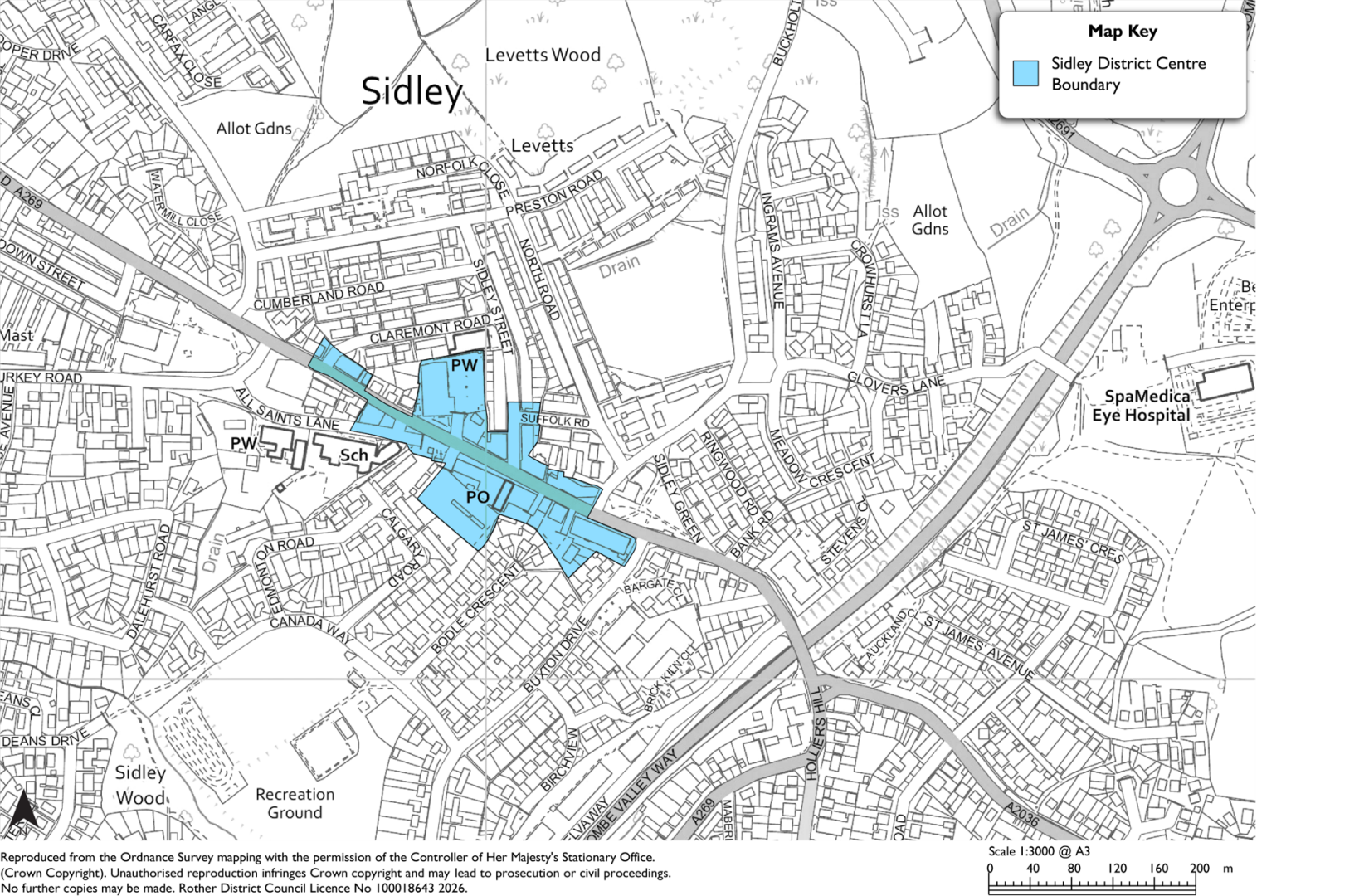
4.42The Town Centre, District Centre and Primary Shopping Area boundaries designated by Policy ECO6 are shown in Figure 4.3 to Figure 4.7 below.
Bexhill Town Centre
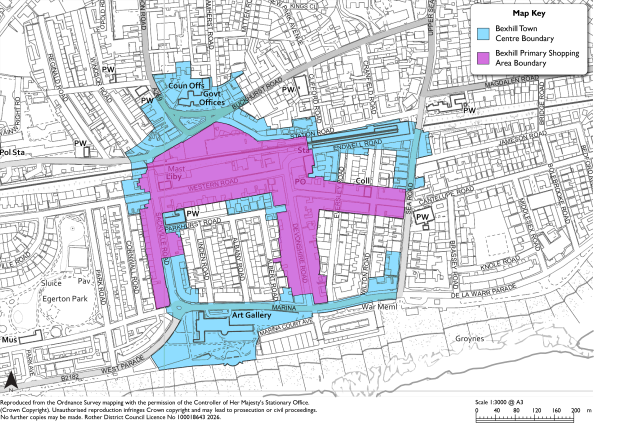
4.43Bexhill-on-Sea Town Centre is the district’s principal commercial, service, leisure and cultural centre, benefiting from its Edwardian coastal setting, strong independent business sector and significant cultural assets, particularly the De La Warr Pavilion. The centre has experienced a decline in comparison retailing and increased vacancies in some areas, although independent business areas continue to perform comparatively well and support the centre's distinctiveness and resilience. The leisure offer remains heavily focused on food and beverage uses, with limited growth overall and ongoing gaps in gym provision, evening economy depth, and visitor accommodation.
4.44The town is the focus of significant regeneration and investment, including the Bexhill Place Plan, Pride in Place funding and the planned regeneration of the De La Warr Pavilion. Together, these initiatives will improve public spaces, connectivity, cultural facilities and the re-use of vacant buildings, helping to strengthen Bexhill's role as a more diverse, accessible and experience-led destination, supporting its vitality, visitor economy and long-term resilience.
Rye Town Centre
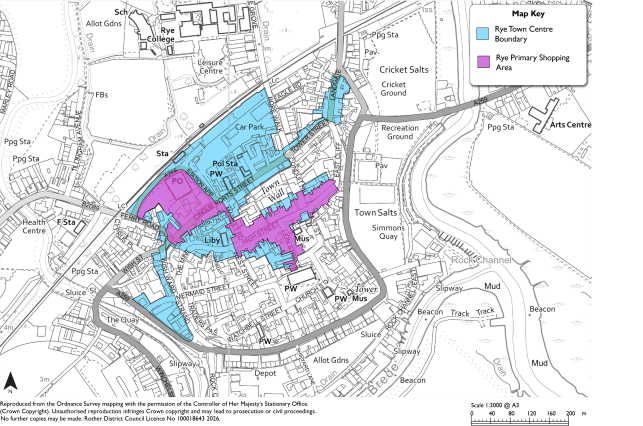
4.45Rye is a historic citadel and tourism-led market town whose medieval character, conservation status and heritage assets are central to its identity and economic role. The town's retail and service offer is strongly underpinned by independent businesses, which account for 97% of all outlets. Rye Town Centre remains stable and resilient, with growth in convenience, leisure, restaurant and visitor accommodation uses reinforcing its role as a destination and reflecting wider trends towards more service- and experience-led centres, although gaps remain in areas such as fitness and broader cultural provision.
4.46Vacancy levels have fallen to around 9%, indicating healthy demand, although some vacancies remain concentrated along parts of the High Street. While recent investment has largely been focused on business support rather than major development, there remains a strong commitment to coordinated action to support the town centre's long-term vitality and visitor economy.
Battle Town Centre
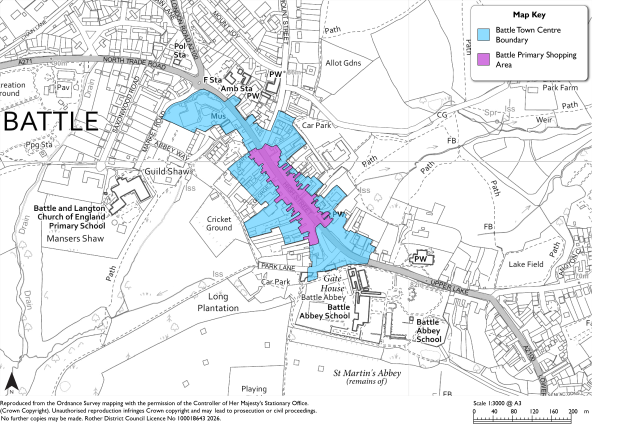
4.47Battle is the smallest of the district’s town centres, functioning as a historic market town serving both local residents and visitors attracted by its heritage assets, particularly Battle Abbey and being the site of the famous 1066 Battlefield. Located within the High Weald National Landscape, the town centre is defined by its historic character, strong independent business sector and heritage-based tourism role.
4.48The centre remains stable, with only a modest decline in commercial units since 2021 and some growth in leisure uses, particularly bars and restaurants, although there remain gaps in provision such as the absence of modern fitness and leisure facilities. Vacancy levels remain relatively low at 9.6%, indicating healthy occupancy, although some vacancies are concentrated along the High Street. Recent investment has focused on heritage-led improvements, with the Blackfriars development expected to increase footfall and support the town's long-term vitality, tourism offer and resilience.
Sidley and Little Common District Centres
4.49Sidley and Little Common are designated as District Centres within the hierarchy established by Policy ECO6. While smaller in scale than the District's Town Centres, they perform an important role in meeting the day-to-day shopping and service needs of their local catchments and contribute to the creation of sustainable communities by supporting access to local facilities close to where people live. Together with the Town Centres, they form part of the district's network of centres and support the application of the sequential approach to town centre development. The designated District Centre boundaries are shown in Figure 4.6 and Figure 4.7 below.
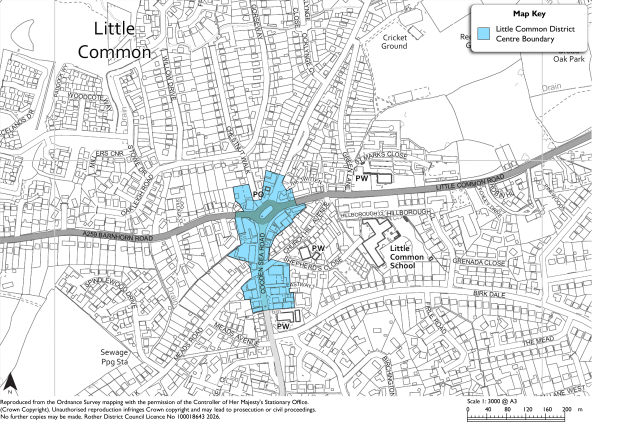
The wider district
4.50 No other areas outside of the towns of Bexhill, Rye or Battle have the scale, function or concentration of town centre uses necessary to justify designation as a District Centre. The district’s village centres continue to serve more day-to-day needs and are often served by a convenience store and a small number of other retail uses and services. Such uses will be supported to maintain the vitality of rural communities.
4.51Ravenside Retail Park in Bexhill functions as Rother’s principal out of Centre retail destination and an important component of the district’s overall retail offer. However, it is recognised that the retail park attracts a significantly greater share of comparison expenditure than Bexhill Town Centre. Any additional out of Centre retail development has the potential to undermine investment and expenditure retention within the district’s centres. Proposals at Ravenside, and more so any proposals for new edge and out of Centre retail, would therefore need to be carefully considered in accordance with the sequential test and the Impact Assessment.
4.52Small-scale local provision for local retail, leisure or community facilities may be acceptable in other locations, where these support the wider development strategy and assist in creating sustainable neighbourhoods. Proposals will be expected to demonstrate that they are appropriate in scale and function and do not adversely affect the vitality and viability of existing centres. In accordance with national planning policy, the sequential test does not apply to applications for small scale rural offices or other small scale rural development.
Impact assessments
4.53 In accordance with national planning policy, proposals for retail and leisure uses located outside town centres should be accompanied by an impact assessment to consider the effect on town centre investment, vitality and viability. Local Plans may identify locally set floorspace thresholds, proposals above which a Retail and Leisure Impact Assessments will be required. In contrast with the national ‘default’ floorspace threshold of 2,500 sqm, Rother’s RMTCU Study identifies an appropriate floorspace threshold of 280 sqm. This is based on current market trends that see the main grocery operators focusing on smaller convenience stores which tend to have a minimum gross floorspace of between 280 sqm and 372 sqm. Stores below 280sqm are exempt from Sunday trading restrictions, while those above 280 sqm are defined as ‘large shops’ according to the Sunday Trading Act. The Act intends to protect smaller stores from competition from the larger supermarket operators. It is therefore considered that stores of over 280 sqm are unlikely to be a purely local facility and may draw trade from outside their immediate area and potentially impact on existing stores and centres.
Need for floorspace for retail and leisure uses
4.54Shopping habits nationally have changed significantly in recent years. The growth in online shopping has diversified the retail market away from ‘physical shopping’. This trend is commonly measured through Special Forms of Trading (SFT), which includes internet shopping and other forms of non-store retailing. SFT’s share of total retail sales increased from around 5% in 2006 to approximately 28% in 2026 and is forecast to rise further to 37.8% by 2041. This has particularly affected comparison goods (including goods such as clothing, electrical goods and household items). Convenience goods retailing, which primarily relates to food and grocery shopping, has generally been more resilient to the growth of online shopping. Nevertheless, the online market share for convenience goods has risen to 18% in 2026 and is forecast to rise to 24.9% by 2041.
4.55This, combined with the effect of a difficult economic period, changing retailer business models and increasing operating costs, mean that expenditure growth does not necessarily generate a corresponding need for additional floorspace. These factors have had major implications for retailers’ space requirements and are changing the retail landscape of our towns and cities.
Retail
4.56 The Rother RMTCU Study, Update and Addendum (2026) considered the need for new convenience retail floorspace during the plan period. It found that district-wide, there is an over capacity, due mainly to existing edge and out of centre capacity. If this location type is discounted, the Study found a very small need (equivalent to approximately one small convenience store) across town and district centres, villages and local shops combined. Given this, there is no strategic need to identify land through the Local Plan for additional future growth for new convenience retail floorspace.
4.57Comparison goods retail expenditure within the district is forecast to grow by approximately 30% by 2042, however the RMTCU Study forecasts either nil, very slight, or negative capacity for Rother throughout the Plan period. This is due to the continued growth of online retailing as well as the expectation that this growth will largely be accommodated through the optimisation of existing retail floorspace. In relation to retail overall, the Study concludes that the Council should plan for less rather than more retail floorspace, with a focus on repurposing and diversifying existing centres rather than allocating additional retail land.
4.58However, the capacity forecasts should not be viewed in isolation. Whilst the evidence does not justify allocating sites for additional retail floorspace, market demand may still give rise to viable retail proposals in the Plan period. Therefore, the Local Plan does not preclude the consideration of opportunities that could improve the retail offer, particularly proposals which could improve expenditure retention from competing locations outside the district. Development will be required to prioritise town and district centres in line with national planning policy and Policy ECO6, with proposals in other locations being subject to the sequential test and Impact Assessment requirements set out.
4.59It should be noted that planning legislation[99] provides that a change of use of a building from a use falling within Class E (commercial, business and service – including retail) to use Class C3 (dwellinghouses) is “permitted development” providing it meets certain tests set out in legislation, and subject to an application for Prior Approval. This means the Council cannot resist such changes of use in principle, including in designated town centres, although the legislation does require consideration of impacts of such proposals on the character and sustainability of conservation areas. Small local shops selling essential goods, however, are treated differently in legislation, being within use Class F2(a)[100] and are not subject to the same permitted development rights. Proposals involving the loss of a shop within use Class F2 will be resisted in line with Policy ECO4.
Leisure
4.60Leisure forms a diverse range of use categories, and forecasting for new leisure uses is more problematic than for retailing, being highly complex and dynamic. Consequently, no overall floorspace need is identified by the RMTCU Study. However, leisure expenditure is forecast to increase over the Plan period, by around 30.8% by 2042, with the strongest growth expected to be driven by food and beverage expenditure, followed by cultural services. This provides opportunities to strengthen the role of town centres and support the visitor economy.
4.61Restaurants, cafes, bars and similar uses play an important role in supporting town centre vitality, generating linked trips and increasing time spent in the centre. Food and beverage uses within town centres, including as part of mixed-use developments, will be supported as part of a “town centre first” approach. Ultimately however, specific sites will be decided by the market.
4.62In terms of theatre, music and the performing arts, improvements to the De La Warr Pavilion in Bexhill, have the potential to strengthen the district’s role as a cultural destination. To this end, Policy BX2: Bexhill Cultural Area, identifies Bexhill town centre as the focal point for arts, culture and tourism activities, and seeks to protect significant cultural uses. This will in turn help to stimulate trade to other businesses within the leisure sector that would benefit from linked trade, such as food and beverage outlets and potentially increase demand for overnight visitor accommodation.
4.63The RMTCU Study also identifies a demand for an improved active leisure and fitness provision within the district. While the existing leisure offer generally performs well in meeting day-to-day needs and supporting visitor activity, there remain gaps in provision, particularly in relation to branded gyms, larger scale leisure attractions and family entertainments venues. These gaps contribute to expenditure leakage to competing centres such as Hastings and Eastbourne. Opportunities to address these deficiencies are constrained by market factors, including viability, operator requirements, the scale of the local catchment and the limited presence of anchor attractions such as major cinemas. Consequently, future opportunities are likely to focus on incremental improvements to existing provision, including strengthening the food and beverage offer, supporting cultural facilities and accommodating smaller-scale leisure operators. More significant leisure developments are likely to remain dependent on market demand, viability considerations and the ability to attract investment.
4.64Given the complexity of this sector, as well as the problematic nature of forecasting for future leisure capacity, the Local Plan supports a flexible and positive approach to leisure development, with proposals assessed against the sequential test and Impact Assessment.
Policy ECO7: Tourism Activities, Facilities & Accommodation Comment
|
Status |
Strategic |
|
Priorities |
Green to the Core, Live Well Locally, Thriving Local Economy |
|
Strategic Objectives |
1, 4, 6, 9 |
|
|
|
Key evidence and/or guidance
|
|
4.65This policy sets out the Plan’s overarching strategy for tourism development, including visitor accommodation, which forms an integral part of the economic development strategy set out in Policy ECO1 (Supporting a Thriving Local Economy).
Tourism in Rother
4.66Given its broad access to the coast, its beautiful and often remote landscapes, its unrivalled historic assets and settlements, and its relative proximity to London, it is no surprise that the visitor economy is a fundamental component of the district’s economy. The Local Plan strikes a balance between supporting tourism growth and protecting the environment. Consequently, while Policy ECO7 is supportive of tourism proposals, the overall approach is selective, being focused on quality accommodation and sensitive development.
4.67Most visits to the district are day trips (with 5.21 million being recorded in 2022), although there is also a considerable demand for both serviced and self-catered accommodation. It is envisaged that the impacts of climate change, including the growing unsustainability of overseas transit, will equate to a steady trend towards domestic ‘staycation’ holidaying. This represents a growing opportunity for Rother to diversify its tourism offer, extending beyond traditional day trips towards an increasing emphasis on multi-day visits, as day visitors yield lower revenue per person than those staying overnight[101]. It is therefore essential for its tourism sector that Local Plan policy promotes a broad range of visitor accommodation, including higher-quality, sustainable accommodation, both in urban and rural areas.
4.68Nationally, demands for different forms of tourist accommodation have changed significantly in recent years and this is reflected in Rother. The development of new online platforms has led to a rise in the number of short-term holidays lets in many areas, particularly coastal towns. This forms a major part of the structural shift in the last decade away from serviced accommodation like hotels towards non-serviced, typically self-catered, accommodation, also influenced to an extent by the Covid-19 pandemic.
4.69The three main towns of Bexhill, Battle and Rye play important roles in the visitor economy. Rother’s villages are also popular tourist destinations, and tourism is an influential factor in the diversification of the rural economy, including the growing market for local produce and viticulture. Of particular significance is the coastal resort of Camber which has long been a popular tourist destination for people from across the wider region, but which is sensitive, environmentally, being close to protected habitats sites and areas at risk of flooding.
Tourism Focus Areas
4.70The Rother and Hastings Tourism and Visitor Accommodation (TVA) Study (2026)[102] identifies four strategic “tourism focus areas” within Rother district, where there are high concentrations of visitor accommodation. A focused approach to proposals in these areas is recommended, taking into account existing accommodation stock. The four areas are:
- Rye and Winchelsea: including Rye town, Rye Harbour, Winchelsea and Winchelsea Beach;
- Eastern Rother: with a focus on Camber;
- Central Bexhill: Collington, Central and Sackville wards; and
- Battle: with a focus on both the town and the surrounding area.
4.71 Within all of these areas, the TVA study identifies needs for:
- Modern hotels and bed & breakfast establishments;
- Purpose-built self-catering accommodation (that does not result in the loss of existing dwellings);
- Hybrid forms of accommodation, which comprise some serviced elements within a largely self-catered offer.
- Outside of the Bexhill area, there is also support for camping and glamping sites, and these are further considered in Policy ECO8 (Holiday Sites & Accommodation).
4.72Evidence[103]finds that in Camber, Rye, Rye Foreign and Icklesham parishes, there are high numbers of short-term holiday lets and second homes which has, over time, resulted in the loss of dwellings available for residential use. This must be considered in the context of poor housing affordability and a significant unmet affordable housing need throughout the district. As such, any proposals involving a loss of dwellings to holiday accommodation is not supported in these areas[104]. This does not impact on proposals for new purpose-built holiday accommodation, and the TVA study identifies support for holiday parks in Camber in particular. Any proposals in these areas will need to take account of the sensitive environmental setting, with particular regard to flood risks and the proximity of the Dungeness complex of protected habitats sites.
4.73Proposals for quality hotels in the central and coastal area of Bexhill will be particularly supported, when these are compliant with heritage and amenity considerations. The TVA study identifies “aparthotels” as an opportunity in Bexhill, these are serviced apartments that run on a hotel booking system. The Retail and Main Town Centre Uses Study (Update 2026) also identifies a need for additional hotel accommodation in Bexhill town centre. It finds hotels to be particularly under-represented, and that the current lack of choice is likely to constrain opportunities to develop the town’s overnight stay visitor economy. See also Policy BX2 (Bexhill Cultural Area).
4.74The rural offer across much of the district has been attractive for smaller-scale tourism development over the last decade and this is likely to continue, as consumers continue to seek outdoors experiences and rural accommodation formats. It is acknowledged that some small rural sites will be less able to offer access via a range of means of transport. However, in all cases opportunities for sustainable transport should be maximised as far as possible, with EV charging points provided where the only travel option is the private car but the site is otherwise acceptable. Rural sites are, however, often well placed to include biodiversity enhancements as part of development, and these will be required in line with Local Plan policy.
Loss of tourism uses
4.75 There can sometimes be commercial pressures for tourism facilities, in particular visitor accommodation, to change to higher value uses, but such losses have the potential to adversely impact the tourism economy. For this reason, the policy restricts the loss of tourism activities, attractions and visitor accommodation, unless it can be demonstrated that there is no reasonable prospect of its continued use, subject to the requirements set out in Policy DEV4. Nevertheless, it is recognised there may be some relatively low-quality serviced accommodation that is no longer suited to the visitor market, and in some limited instances a change of use may be accepted. However, such proposals will be subject to consideration under policy DEV4 and also against a range of quality measures such as independent customer reviews, trading standards reports, environmental health reports and industry insight, to determine whether the site is genuinely unsuitable.
4.76Additionally, new visitor accommodation will be subject to appropriate controls through a condition(s) following the grant of planning permission that restricts occupancy to holiday use and prevents inappropriate use as a dwelling.
Policy ECO8: Holiday Sites and Accommodation Comment
|
Status |
Non-strategic |
|
Priorities |
Live Well Locally, Thriving Local Economy |
|
Strategic Objectives |
4, 6 |
|
|
|
Key evidence and/or guidance
|
|
4.77The overarching policy approach set through Policy ECO7 is to support tourism activities and facilities, including by increasing the supply of quality serviced and self-catering accommodation, while ensuring compatibility with other policies, especially those that protect environmental character (including landscape character) and amenities.
4.78This policy is specific to holiday accommodation, including caravan and camping sites, which make up a significant and dynamic part of the tourism sector, being historically concentrated on sites near the coast but now taking more varied forms and being more dispersed. This includes the continued growth of self-catered accommodation, particularly advertised through online channels, which means that there are many different types of holiday accommodation and sites present in the district that all help to support the wider visitor economy.
4.79 It is important that new visitor accommodation positively adds to the tourism economy and is viable into the longer term. Therefore, proposals for new holiday accommodation will need to be supported by a business case demonstrating the development will be viable. This business case will normally be independently verified at the applicant’s expense. This is essentially to safeguard against poorly thought-out schemes which could quickly become unsustainable and result in a demand for an unsuitable change of use, for example to residential use in a countryside location.
4.80 It is acknowledged that different forms of holiday accommodation will have specific requirements. In all instances, however, care must be taken in the siting, scale and form development to prevent adverse impacts on the special character of the countryside, particularly on an otherwise undeveloped coastline or in the High Weald National Landscape. In addition, coastal areas are also most often vulnerable to flood risk. Accommodation in more urban areas will equally be required to consider the character of the area, any heritage constraints, and the amenity of neighbouring properties. Given the district’s environmental constraints, the provision of new large static caravan or chalet sites would be most unlikely to be satisfactorily accommodated locally.
4.81The upgrading of existing holiday sites, for example replacing static caravans with chalet or lodge-style units (which are often still legally classed as caravans), can be positive in terms of better meeting customer needs so long as the impact on the wider landscape is acceptable. This may, exceptionally, involve a sensitive, limited expansion of a site.
4.82Changing leisure patterns bring other demands, including for short stay breaks in low key, high quality, self-catering accommodation. Such accommodation may take the form of small lodges or more unusual structures such as shepherd huts or tree houses. Where a scheme involves limited ancillary facilities and generates minimal traffic, as well as not detracting from its setting or harming landscape character, these may also be accommodated. In addition, visitor accommodation serving other countryside uses, for example existing fishing lakes or equestrian facilities, may also be considered where any new buildings can be assimilated into the landscape (including in respect of dark night skies) and the accommodation is wholly ancillary to and an integral part of the principal leisure use.
4.83The siting of seasonal touring caravan and camping pitches for holiday use should be visually contained within the rural landscape, not adversely impact on the particular characteristics of the High Weald NL or sensitive ecological areas and have no unacceptable impacts in terms of lighting, traffic, access and other environmental impacts.
4.84Proposals with the potential to generate increased recreational pressure on sensitive habitats including the Dungeness Complex[105] of Habitats Sites will need careful consideration. It may be necessary to restrict the scale of development and length of season and require the provision of alternative recreational space within the site, and the provision of guidance about the sensitivity of relevant Habitats Sites.
4.85Some significant areas of the district are at risk from coastal and/or fluvial flooding. Proposals for both permanent and seasonal accommodation, the provision/extension of sites, or extension of occupancy periods, will not be supported in areas of high flood risk (from any source) unless a Flood Risk Assessment, undertaken in accordance with national planning policy, has demonstrated the development can be satisfactorily accommodated. Proposals should have regard to the likely impact of hard-standings and other impermeable surface treatments on flooding, and also the impacts of climate change which could increase flood risks in the future.
4.86While there has been a trend to move away from seasonal controls on permanent sites to allow all-year-round use, it is essential that holiday sites remain available as tourist accommodation and do not develop, or become seen, as low-cost homes to be purchased or occupied by persons without a permanent residence elsewhere. As well as the loss to the tourism economy, permanent residential occupation has infrastructure impacts, notably on highways and local services, including schools.
4.87On sites with static units, established practice is to impose conditions on any new permissions to the effect that any unit is only occupied for holiday purposes and not as any person’s sole or main place of residence; and also, that the owners/operators of the site should maintain an up-to-date register of the names and main home addresses of all occupiers of the units.
4.88Seasonal sites will be limited to holiday use, and the occupation period will usually be restricted to prevent use all year round. This would normally be between April and October but may be longer depending on the type and scale of accommodation. This will be assessed on a case-by-case basis.
4.89In line with the Local Plan’s Live Well Locally priority, proposals should demonstrate that they have had sufficient regard to matters of sustainability, including sustainable and active transport where possible, in accordance with other Local Plan policies. This aligns with a wider national trend of 85% of travellers saying that more sustainable travel is important to them[106].
Policy ECO9: Agricultural Development & Forestry Comment
|
Status |
Strategic |
|
Priorities |
Green to the Core, Thriving Local Economy |
|
Strategic Objectives |
3, 4, 6, 8 |
New Agricultural Tracks
|
|
|
Key evidence and/or guidance
|
|
4.90Rother is a predominantly rural district, and the primary economic function of the countryside is agriculture and the production of food; with some 70% of the area of Rother district being classed as farmed land by DEFRA. Rother’s agricultural land is of mixed quality; mostly Grade 3 but with significant areas of higher quality Grade 2 towards the east of the district along the Brede Valley and East Guldeford Level.
4.91It is important to recognise that with 83% of the district being within the High Weald NL, the form of agriculture within the district is generally less intensive in nature compared to other rural areas. This is reflected in the High Weald’s medieval field pattern consisting of small, irregularly shaped fields bounded by hedgerows and woodlands.
4.92The High Weald Management Plan emphasises that certain forms of agriculture are an integral part of the maintenance of the High Weald’s medieval landscape, especially where the production of food is intended for local markets. Changes in agricultural practices during the 20th century saw a decline in traditional land and woodland management, with a consequent decline in skills in environmentally sensitive land management. Maintaining and developing such skills and practices, offers opportunities for local employment and has a vital part to play in maintaining the district’s distinct landscape character, especially in the High Weald. Key threats identified by the Management Plan include the fragmentation of farm holdings due to an increase in non-farming land ownership, the loss of agricultural workforce, and a reduction in livestock grazing and the associated loss of farm infrastructure, including the loss of livestock markets and abattoirs, and the degradation of pasture and soils.
4.93All development located within or having a potential impact on the National Landscape will need have regard to the HWNL Management Plan in accordance with Policy LAN2 (High Weald National Landscape).
4.94New agricultural buildings are often permitted development, not requiring planning permission, subject to requirements that the farm holding is over a certain size, with limitations for building size also relevant. In Rother, where farm sizes are smaller than national averages, new agricultural buildings may therefore be more likely to require planning permission.
4.95Farming is often at the forefront of dealing with the effects of the climate crisis. including increased risks of drought and water scarcity. In response, farms may require infrastructure such as on-farm water storage reservoirs to improve resilience and support food production. Where appropriately located and designed, such development can help agricultural enterprises adapt to changing climatic conditions and will be supported. On-farm water reservoirs would require a licence from the Environment Agency for the abstraction of water.
4.96 In addition, modern farming practices often require new agricultural buildings to meet specific needs. It is also recognised that new forms of agriculture, including viticulture and beer production, are becoming increasingly important within the rural economy, with local beer production in particular being marketed in local urban areas.
4.97The policy establishes the approach for dealing with planning applications for development needed to address the specific requirements of agriculture within Rother that does not constitute Permitted Development. To ensure viable farming industries, these will be supported in principle, though whilst the size and mass of such buildings is inevitably dictated by their function, care is still needed in their siting, design and materials, to minimise the visual impact on the landscape character of the countryside.
4.98 The viability of farming relies on a range of supporting infrastructure within the food supply chain. The Council recognises the importance of local abattoirs and other agricultural processing facilities in supporting livestock farming, animal welfare, local food production and the rural economy, particularly in light of the prevalence of local, organic meat production in the High Weald. In recent years the availability of such facilities across Sussex and the South East has declined (including following the closure of the Tottingworth abattoir in Wealden district), an issue that has been highlighted by the National Farmers Union. Proposals for such facilities will be supported where they accord with the other policies of the Plan.
4.99Forestry operations and associated development can give rise to noise, dust and traffic impacts. Proposals should therefore be located and designed to avoid unacceptable impacts on residential amenity and other sensitive receptors.
4.100Proposals for new agricultural tracks must use a landscape-appropriate choice of surface material such as crushed stone, hoggin or road planings, permeable where possible, and avoiding tarmac. In addition, particular care should be taken in and in close proximity to woodlands, including ancient woodlands, where the location and surface material of any new/enlarged track should not adversely impact on root areas of trees, the biodiversity of ground flora, or landscape character.
Policy ECO10: Agricultural Diversification Comment
|
Status |
Non-strategic |
|
Priorities |
Green to the Core, Thriving Local Economy |
|
Strategic Objectives |
3, 4, 6, 8 |
|
|
|
Key evidence and/or guidance
|
|
4.101National planning policy supports the sustainable growth of businesses in rural areas, including through the development and diversification of agricultural and other land-based businesses. This policy offers in principle support for such schemes, both through the reuse of existing redundant buildings and in some circumstances through new development. Diversification schemes can include, for example, workshops, farm shops or tourist facilities, and other employment uses such as offices. There are often high interdependency and mutual benefit between developing markets for local food production and other business activities.
4.102 The diversification of traditional rural businesses has by now become an established means of supporting the agricultural activities that are integral to the vitality of rural areas. At the same time, adding new farming activities to changing farming needs and development economics have meant that many former farm buildings, historic and modern, have become available for conversion and re-use.
4.103What is essential to diversification schemes, in contrast with other businesses in the rural areas, is that they add value to the established agricultural or other land-based business while remaining ancillary in function.
4.104 For developments within the High Weald National Landscape (HWNL), schemes will need to have regard to the High Weald Management Plan and associated guidance published by the HWNL Unit. The Management Plan sets out support for farm diversification projects subject to conserving the National Landscape and not adversely impacting on the agricultural viability through retaining sufficient productive land and compatible uses.
4.105It is acknowledged that by their nature, rural diversification schemes will often be in less accessible locations, unable to offer access via a wide range of means of transport. However, opportunities for sustainable transport should still be maximised as far as possible, with EV charging points provided where the only travel option is the private car but the proposal is otherwise acceptable.
Policy ECO11: Equestrian Developments Comment
|
Status |
Non-strategic |
|
Priorities |
Green to the Core, Thriving Local Economy |
|
Strategic Objectives |
3, 4 |
|
|
|
Key evidence and/or guidance
|
|
4.106The Rother area continues to be a popular area for equestrian activities. Its countryside provides an attractive environment for horse riders and there is a good network of bridleways throughout the district. Equestrianism is recognised as a countryside pursuit and has a role in supporting the rural economy.
4.107This policy aims to accommodate equestrian developments whilst setting out the key considerations, notably in terms of the potential harm to the character of the countryside and particularly the High Weald NL so they are sensitive to their context.
4.108While there is a limited number of larger commercial centres in the district, it is small-scale facilities for individual and private pursuit that predominantly come forward as planning applications. Typically, proposals for stables will include a tack room as well as external hard-standing and manure bays, but may also include a sand school, fencing and jumps, as well as new access from the highway.
4.109A balance needs to be struck between meeting the desires of the equestrian community and at the same time safeguarding the intrinsic value and locally distinctive rural character and landscape features of the countryside. This is especially the case in the High Weald NL, the conservation and enhancement of which is afforded great weight.
4.110The High Weald National Landscape is particularly vulnerable to new development, including on the fringes of settlements. New buildings and hard surfaces – access roads or sand schools – are not always easily accommodated without some impact on the fields, small woodlands and farmstead meadows which make up the essential character of the High Weald NL.
4.111Much of the rural area beyond the High Weald NL is also sensitive for other reasons; notably, the lower and open Levels extending eastwards towards the Romney Marsh are ecologically sensitive and subject to national and international protection. More generally, equestrian developments can have ecological impacts, for example, through habitat or species loss, nutrient enrichment, or the use of lighting. Sites should also have regard to avoiding the loss of higher quality agricultural land.
4.112Other than the possibility of utilising former farm or other commercial buildings for new uses, there is limited scope within the countryside to accommodate further commercial equestrian enterprises. However, there is scope for equestrian development in the countryside that is limited in scale, although there is a need to manage the increasing pressures from proposals for new isolated stables and, at the other extreme, from a cumulative impact of stabling and equestrian facilities in a concentrated area. Applications should clearly demonstrate that proposed buildings, facilities and associated works are genuinely required for, and proportionate to, the equestrian use of the site. Where planning permission is granted, conditions may be imposed, where appropriate, to ensure that buildings and facilities are retained for equestrian purposes.
4.113Ordinarily, new development should be sited close to existing built development and close to the bridleway system. Mobile field shelters can often be an appropriate way of catering for equestrian uses, although this is not always practicable.
4.114Where applications come forward in more remote locations and permanent buildings are required, new development will be expected to meet a number of criteria aimed at protecting the character of the countryside and the amenities of both local residents and users of the countryside.
4.115Particular control is necessary over the location of any new equestrian development and the size, siting and design of all new buildings and associated facilities. Floodlighting will rarely be acceptable for private/ domestic stables in the countryside, particularly in the High Weald NL and in those areas identified as having “dark skies”. Any lighting necessary for commercial uses will need to be carefully designed in accordance with Policy LAN4 (Light Pollution & Dark Skies). Extensive access roads or excavations other than of a minor nature to enable the formation of a sand school (or manège) are not appropriate in the countryside.
4.116In assessing applications, adequate provision should be made for the safety and comfort of horses in terms of land for grazing and exercising. Such provision will help to address the issue of the excessive sub-division of fields and over grazing/loss of soil structure. While there is not a common standard applicable throughout the plan area, depending on how the horses are kept and the nature of the land, a desirable guideline would suggest stocking at a density of one hectare per horse.[107]
Policy ECO12: Local Employment & Skills Comment
|
Status |
Non-strategic |
|
Priorities |
Live Well Locally |
|
Strategic Objectives |
2, 5, 9 |
|
|
|
Key evidence and/or guidance
|
|
4.117Ensuring local residents have access to good quality jobs, training and education opportunities is a key part of both the East Sussex Economic Prosperity Strategy and the Rother Economic Recovery Action Plan.
4.118As set out previously in the Local Plan, some of the key challenges to the delivery of sustainable economic development in Rother relate to local skills shortages and gaps, as well as the availability of good quality jobs and training opportunities. These are determinants of deprivation and inequality experienced in some areas of the district. For example, in the 2025 Indices of Multiple Deprivation, Rother ranked 91st out of 296 local authority areas for employment deprivation, and 72nd for education, skills and training deprivation.
4.119The Council has an established process of using planning obligations to secure Local Employment and Skills Plans (LESP) from larger developments. LESPs set out opportunities for, and enable access to, employment and the upskilling of local people through the construction phase. Where appropriate, operational phase employment and skills measures will be sought where long-term jobs are created. Opportunities are to be made available to qualifying residents from the local area as far as possible.
4.120LESPs will be required from all developments over the threshold of 20 or more gross dwellings and 1,000 sqm or more gross non-residential floorspace. Qualifying developments are required to make a financial contribution to the Council. The contribution is required to fund the Council's role in coordinating, facilitating, administering, monitoring and reporting on the delivery of the LESP, including its work through the Rother Employment and Skills Forum (RESF) and engagement with local training and employment providers. Financial contribution requirements are set out in the policy, and they are to be index linked for inflation based on the adoption date of the Local Plan.
4.121In addition, certain forms of development (such as energy generation, energy storage, utilities and other specialist infrastructure projects) may not be capable of delivering a conventional Local Employment and Skills Plan due to the highly specialised nature of their construction or operational requirements. Nevertheless, such developments can represent significant capital investment and may generate demand for construction, engineering and technical skills. Where the Council is satisfied that the delivery of a meaningful LESP would not be practicable, it may seek an appropriate financial contribution through a planning obligation towards local employment, training and skills initiatives. Such contributions will be directed through programmes and priorities identified by the Rother Employment and Skills Forum and used to support vocational training, apprenticeships and other measures that improve access to employment opportunities for local residents. The scale of any contribution would be proportionate and agreed through the planning application process having regard to the nature of the development, its construction value, construction period, workforce requirements and the potential employment and skills opportunities arising from the development.
Implementation
4.122Planning obligations will be established for qualifying developments, Before the development can commence, the developer will need to produce an LESP and submit this to the Council for approval.
4.123The LESP should include data that identifies the employment and skills requirements for the local area, as specific as possible to the location of the development. The LESP will need to set out arrangements working directly with local employment/training agencies as part of an employment and training consortium through the Rother Employment and Skills Forum (RESF).
4.124The LESP must specify the provision of training opportunities and other initiatives in respect of the vocational and employability skills required by the developer, their contractors and future occupiers, for new jobs created by the Development both during its construction and operational phases.
4.125LESP targets are likely to be aligned with the approach set by the National Skills Academy, which has developed National Skills Academy for Construction Client Based Approach[109]to provide a framework for producing and implementing an Employment and Skills Strategy for construction projects. This framework formulates benchmarks to provide target outputs for a range of employment and skills areas such as apprenticeships and entry into employment. These benchmarks have been formulated for a range of construction types and bands. Requirements are ultimately based on the overall value of a given development. This framework is then used to set locally specific employment, training and skills development opportunities, targets which are identified through the LESP, the skills development opportunities locally available and in coordination with the RESF.
4.126The developer is required to implement the approved LESP and promote the objectives of the approved Plan. The targets of the LESP are set out in a Delivery Plan that spans the length of the LESP. This LESP Delivery Plan is openly shared with the RESF. The ongoing delivery of the LESP’s agreed employment, training and skills targets, will be formally and informally supported, monitored and reported on by the Council.
4.127The monitoring considers whether the LESP targets are being achieved at the correct standard, including whether opportunities are being offered to local people as agreed.
4.128Financial contribution for skills and training align with the cost of the build and its finished value, the build-time to completion, and the corresponding time that the Council is involved in the support and monitoring of the LESP targets.
Employment and Skills Forum (RESF)
4.129 The RESF is a local partnership that brings together organisations such as Rother District Council (which plays a leading role), East Sussex County Council, Jobcentre Plus, local colleges like Bexhill Sixth Form College, and voluntary groups such as Rother Voluntary Action, alongside training and employment support providers. It aims to improve collaboration, share information, and align services so residents can more easily access jobs, training, and support, helping to strengthen the local economy, address skills gaps and develop improved links & support for local businesses.
4.130The Rother Employment and Skills Forum (RESF) plays an integral role in delivering employment and skills measures at the heart of Employment and Skills Plans by acting as a coordinating and oversight body. The S106 Planning Obligation will itself specify that as part of delivering an Employment and Skills Plan, the developer must work directly with the RESF. Through its partnership of organisations such as the local authority, Jobcentre Plus, colleges, and training providers, the forum has assisted in aligning developer commitments with existing local provision, ensuring that employment and training opportunities tied to developments are targeted towards local residents. In this way it puts developers into contact with the training and employment providers, enables the production of realistic and locally relevant employment and skills plans, helping to ensure that S106 obligations are not only met but deliver meaningful, long‑term benefits to the local workforce and economy.
[90] Invest 2035: The UK’s Modern Industrial Strategy (UK Government, June 2025).
[91] HEDNA (2024)
[92] Office for National Statistics. Housing affordability in England and Wales.
[93] Tourism and Visitor Accommodation Study (2026).
[94] Use Classes as defined by the Town and Country Planning (Use Classes) Order 1987 (as amended) and Town and Country Planning (General Permitted Development) (England) Order 2015 (as amended).
[95] This includes an employment use within Use Classes E(g) (i, ii, iii), B2 and B8, a community facility within Use Classes F1 or F2, a local shop within Use Class F2, a theatre, public house, venue for live music performance, cinema, concert hall, or any form of tourist accommodation or attraction...
[96] Main town centres uses are defined as: Retail development (including warehouse clubs and factory outlet centres); leisure, entertainment and more intensive sport and recreation uses (including cinemas, restaurants, drive-through restaurants, bars and pubs, nightclubs, casinos, health and fitness centres, indoor bowling centres and bingo halls); banks; professional services; offices; and arts, culture and tourism development (including theatres, museums, galleries and concert halls, hotels and conference facilities) (NPPF, 2026)
[97] NPPF December 2023 definition: a location within 300 metres of a town centre boundary.
[98] A power for Local Authorities introduced through the Levelling Up and Regeneration Act 2023
[99] The Town and Country Planning (General Permitted Development) (England) Order 2015 (as amended)
[100] Defined as: shops (mostly) selling essential goods, including food, where the shop’s premises do not exceed 280 square metres and there is no other such facility within 1000 metres.
[101] Hastings and Rother Tourism and Visitor Accommodation Study 2026, Tomorrow’s Tourism
[102] Appendix VII – Tourism Focus Areas – Rother
[103] Recommendations of the Airbnb Task and Finish Group, Cabinet report, Rother District Council, 16 June 2025.
[104] This only applies to development requiring planning permission.
[105] This comprises the Dungeness, Romney Marsh and Rye Bay Special Protection Area (SPA) and Ramsar site, and the Dungeness Special Area of Conservation (SAC).
[106] Hastings and Rother Tourism and Visitor Accommodation Study 2026, Tomorrow’s Tourism
[107] Managing Land for Horses, Kent Downs AONB Unit (2011)
[108] Development also includes any previously non-qualifying planning application that is amended via a Section 73 Application that meets the above thresholds for development.
[109] Industry standard benchmarks are currently set out in the National Skills Academy for Construction Client Based Approach from 2017. While this is the latest available version, developers would be expected to comply with the latest version as and when these benchmarks are updated.
